


Maintaining service continuity under pressure
Most public services evolve through planned transitions. There is time to understand emerging needs, consult the people who use the service, engage partners and plan what comes next.
But sometimes that well-laid path is not always followed.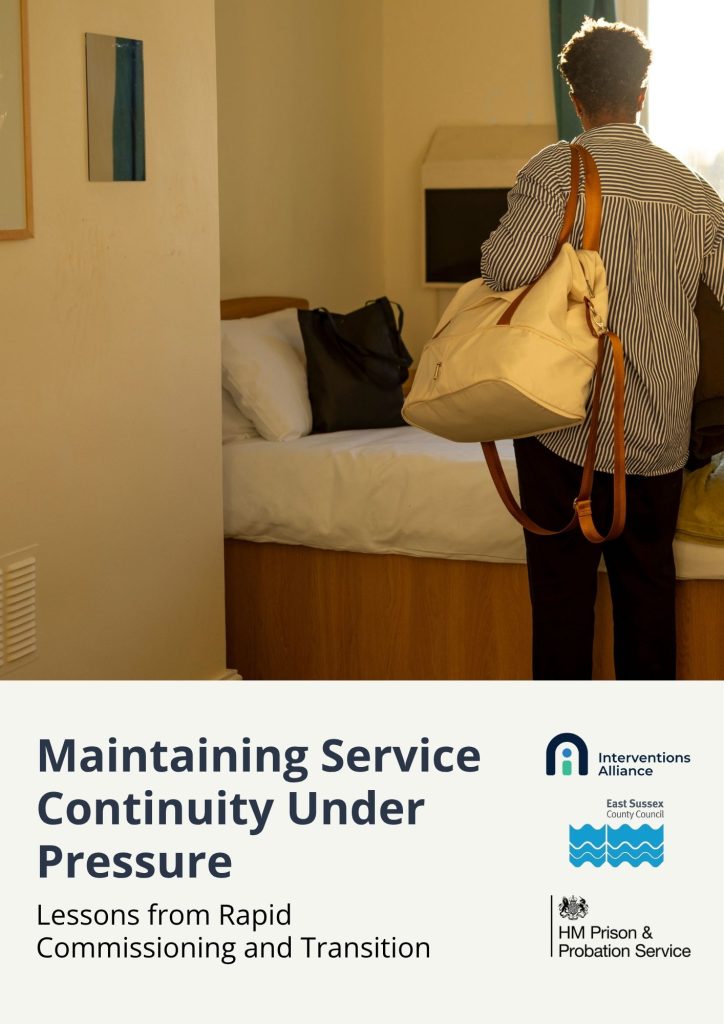
A provider may need to step away unexpectedly because their risk appetite has changed. Or perhaps a mobilisation of a new service may not go to plan. These situations aren’t always anticipated, leaving commissioners with difficult decisions about how to maintain essential services and find a way forward, often with very little time to do so.
Over the past year, Interventions Alliance has supported commissioners through two situations where vital services needed a new provider to step in. There was limited time, incomplete information and multiple organisations to coordinate, but there was one clear priority: maintaining continuity for the people using the service and the colleagues delivering it.
In both cases, services continued without disruption.
Looking back two things stood out. Firstly, how much of our approach to transition had to be developed as we went along. There was no single playbook that answered every question or anticipated every challenge. We had to work things out collaboratively, adapt quickly and learn as we went. The second was that having been through this twice in a year, I no longer think these situations are as unusual as we might assume.
What became clear very quickly was that maintaining continuity is about far more than finding another provider. Staff need reassurance about their future. Communications must be coordinated across multiple organisations. Property arrangements and landlord approvals can suddenly become the critical path. In other words, the commissioning agreement is only part of the picture. Maintaining continuity depends just as much on people, relationships, communications, property and timing.
By the end of both processes, we had developed approaches that made managing the transition much more straightforward. We had learned what we needed to establish early, where delays were most likely to arise and which conversations were particularly important to have from the outset.
As a learning organisation, we decided to sit down with the commissioners involved and reflect on what happened, what worked, what we would do differently and what we wish we had known at the beginning.
The result is Maintaining Service Continuity Under Pressure: Lessons from Rapid Commissioning and Transition. It brings together the lessons, tools and approaches we wish we’d had at the outset and shares them with commissioners and providers who may one day find themselves facing similar circumstances.
At the end of the report, we’ve included a 7-step readiness toolkit, proving some practical steps to consider – because it’s easier to start with something than with nothing.
Every situation will be different. But when you’re trying to maintain service continuity under pressure, there are always questions you wish you’d asked earlier. None of us hopes to find ourselves in circumstances where a vital service needs transition at pace. But if we do, there’s no reason every commissioner and provider should have to start from a blank sheet of paper.