


Understanding behaviour, supporting change: Inside the work of a BCP
What does it take to help someone change behaviour that has caused harm? And what skills do you need to support that change?
Behaviour Change Practitioners (BCPs) draw on psychological insight, professional curiosity and relationship-building skills to help people understand their behaviour, recognise its impact and develop new ways of responding. It’s a complex profession that combines support and challenge, with accountability and the safety of victims, survivors, children and the wider public at its heart.
In this blog, Vic Curtis, Head of Behaviour Change at Interventions Alliance, explores what the role involves, why change can be difficult and how practitioners develop their expertise. She also explains why experience gained outside the criminal justice sector can provide valuable foundations for a career in behaviour change.
Understanding why behaviour happens
Changing behaviour is rarely straightforward. Even when we recognise that something needs to change, putting that understanding into practice can be difficult. Established habits, personal circumstances and past experiences can all influence how we respond to challenging situations.
For people who have caused harm, the process can be particularly complex. Some may initially minimise or justify their actions, or struggle to recognise their impact on others. As their understanding develops, feelings of shame and guilt may emerge.
A BCP helps participants explore these patterns, understand the consequences of their behaviour and identify their own reasons for change. Practitioners work to strengthen motivation, helping people move from external expectations towards an internal commitment to doing things differently.
That process takes time. Participants need opportunities to learn, practise and apply new skills in different situations so they are better equipped to use them when it matters.
Ultimately, the practitioner can support and guide change, but the responsibility for making it rests with the individual.
Building relationships while maintaining accountability
Relationships are central to effective behaviour change work. Practitioners need to create an environment where participants feel able to reflect honestly, explore difficult experiences and engage with new ways of thinking and behaving.
At Interventions Alliance, our interventions take a trauma-informed approach and are underpinned by motivational interviewing skills. We work openly and transparently, explaining how information will be used and the limits of confidentiality where safeguarding concerns arise.
Supporting someone does not mean excusing their behaviour. BCPs work in a non-collusive way, helping participants recognise the harm their actions have caused and understand the impact on other people, including children.
For example, a practitioner might acknowledge that someone felt angry, rejected or afraid in a particular situation without suggesting those feelings justified abusive behaviour. Validating an emotion is not the same as validating the harmful action that followed.
This balance between empathy, challenge and accountability is fundamental to the role.
Professional curiosity: looking beneath the surface
One of the most important qualities of an effective BCP is professional curiosity.
As Head of Behaviour Change, I see the ability to ask thoughtful questions, explore why something happened and remain open to new information as essential to good practice. This means looking beyond the first explanation and considering the wider circumstances influencing someone’s behaviour.
It also means recognising that every participant is different. Practitioners need to adapt their approach to individual needs, motivation and readiness to engage, while remaining alert to risk and safeguarding responsibilities.
Accurate reporting, risk assessment and risk management are equally important. Practitioners must exercise sound judgement, work with partner agencies and sometimes make difficult decisions when information cannot be shared with a participant.
Training, supervision and experience help practitioners develop these skills. But a genuine desire to understand people, ask questions and look beyond the obvious is a valuable starting point.
Can people who have caused harm really change?
This is a question I am often asked. Every person’s journey through an intervention is different, and there are no guarantees about individual outcomes. Motivation, readiness to engage and the circumstances surrounding a person’s behaviour can all influence progress.
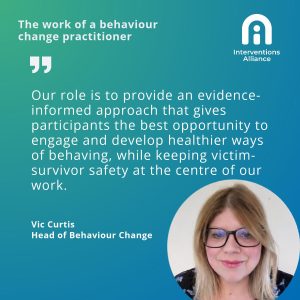
Our role is to provide an evidence-informed approach that gives participants the best opportunity to engage and develop healthier ways of behaving, while keeping victim-survivor safety at the centre of our work.
Meaningful change involves more than saying the right things. It requires people to recognise the impact of their actions, take responsibility and practise different responses in real-life situations.
There may be setbacks along the way. When these happen, practitioners help participants examine what went wrong, identify what they can learn and consider how to respond differently in future. They must also remain alert to risk and work collaboratively with relevant agencies to support safety.
This is why behaviour change requires practitioners to combine an understanding of people with professional judgement, accountability and a clear focus on preventing further harm.
A career that keeps developing
One of the things I value most about behaviour change is that there is always something new to learn. In more than 25 years working in the criminal justice sector, I have never felt that I have had a boring day. The work brings new challenges, different perspectives and opportunities to work with partner agencies to understand complex situations.
At Interventions Alliance, we support practitioners to develop their knowledge and expertise through training, ongoing support and constructive feedback. Development opportunities include cognitive behavioural therapy (CBT), dialectical behaviour therapy (DBT), risk assessment and risk management.
Practitioners can build experience across different interventions, from psychoeducational work to domestic abuse interventions and, with further experience, specialist stalking interventions. Our Quality Development Officers observe interventions and provide feedback to help practitioners reflect on their practice and continue to grow.
There are opportunities to progress, too. All our managers, including me, began their careers as Behaviour Change Practitioners. That experience provides a strong foundation for understanding the work, supporting colleagues and developing practice.
You do not necessarily need to have worked in criminal justice before to consider this career. Experience in psychology, social care, mental health, education, youth work, substance misuse, housing, counselling and community services can all provide valuable transferable skills.
What matters is a willingness to understand behaviour, build relationships, think critically and support people to take responsibility for change.
Helping to create safer futures
Behaviour change work is not always easy. It requires resilience, reflection and the ability to navigate difficult conversations and complex risks.
But it also offers the opportunity to make a meaningful contribution to public protection by helping people recognise harmful patterns, take responsibility and develop the skills to behave differently.
For me, knowing that our work helps protect victims, children and the wider public is what makes the challenging days worthwhile.
Could behaviour change be your next career?
If you have experience supporting people or helping them navigate complex challenges, you may already have skills that could translate into this profession.
At Interventions Alliance, we’re keen to hear from people interested in learning more about a career as a Behaviour Change Practitioner, including those bringing experience from outside the criminal justice sector.
- Get in touch with our team to find out more about the roles, the skills and opportunities to develop your career with us.