


Holding Care and Balancing Risk: The Emotional and Organisational Demands of Working in a Women’s Approved Premises
Women’s Approved Premises (APs) play a vital role in managing risk and supporting rehabilitation, yet the experiences of the staff who work in them remain under-researched.
In a new report, Holding Care and Balancing Risk: The Emotional and Organisational Demands of Working in a Women’s Approved Premises, our Head of Research Kerry Ellis Devitt explores the emotional demands of frontline practice, the impact of system and organisational pressures, and what helps build and sustain a skilled, compassionate workforce.
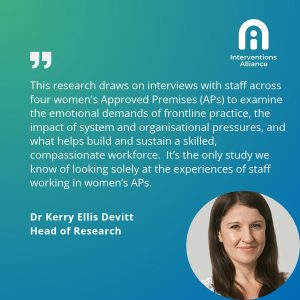
Drawing on interviews with staff across four women’s APs, the study is the only research we know of to focus exclusively on the experiences of staff working in women’s APs, addressing a crucial gap in the evidence base.
Balancing care and risk
Women’s APs are resourced and governed in the same way as men’s, despite the different profiles and needs of women in the criminal justice system. Women’s offending is often linked to trauma, requiring time, engagement and trauma-informed approaches. The limited number of women’s APs can also mean residents are placed far from home, making it harder to maintain contact with probation officers and other vital support services.
The research highlights the emotional labour involved in this work. Staff described the challenge of balancing care with authority, empathy with enforcement, and support with risk management, while building trusting relationships with women with complex, compounding needs.
Maintaining professional boundaries, managing the disappointment of relapse or recall, and navigating the emotional impact of residents’ experiences all placed demands on practitioners.
Alongside these challenges, staff identified wider system and organisational pressures, including administrative and contractual requirements, concerns about inappropriate referrals, and tensions in partnership working. Psychological safety also emerged as an important issue, with some staff describing difficulties speaking openly, feeling heard or expressing professional judgement without fear of blame.
What helps sustain the workforce?
Despite these demands, the research identifies important sources of support and professional resilience.
Colleagues provide vital emotional support, practical help and shared understanding. Staff also valued approachable, compassionate managers who listened, encouraged collaborative decision-making and responded flexibly to individual needs.
Supervision, reflective practice, case consultations, post-incident debriefs and psychological support offered further opportunities to process difficult experiences and strengthen practice. Staff also described the importance of self-care and self-preservation, including maintaining boundaries between their professional and personal lives.
Participants also called for a stronger, more gender-responsive AP model, including additional places, better move-on housing, improved mental health provision and services designed around women’s specific needs.
Crucially, participants spoke of what keeps them in the work – the residents themselves, a belief in justice-involved women’s capacity for change, and the knowledge that even small acts of care can have lasting significance.
 Addressing a gap in criminal justice research
APs are something of a hidden world; the women’s estate, even more so. By shining a light on staff experiences, this research adds to understanding the gender-specific requirements of working with women in community justice contexts.
Its findings underline the importance of recognising the distinct demands of women’s APs, strengthening organisational support and better understanding what it takes to retain the skilled staff who keep these vital services running.
Read the research: