

Surviving Abuse and Rebuilding My Life
The following Story of Hope is from a colleague from Interventions Alliance, who is male survivor of domestic abuse, sharing his experience anonymously.
I met my partner shortly after leaving University. We grew close through work, began a relationship, and eventually bought a home together. As time went on the relationship gradually became defined by control, manipulation and fear.
One of the first major issues was hoarding. What started as equipment for a small events business idea gradually spread throughout our home, filling cupboards, spare rooms and storage spaces until entire areas became unusable. Her belongings eventually overflowed into garden sheds and relatives’ garages. Whenever I tried to discuss the impact, this was having on our lives, she would use phrases like “just in case” or create unrealist scenarios to justify the need to keep items. Often her mood would escalate to anger. During one disagreement, she grabbed my laptop and threatened to break it if ever I threw anything away. After this she would tear open rubbish sacks and forage through bins looking for items she hadn’t approved of being disposed of. If any were found, this would be pursued by her initiating arguments. I had to resort to hiding broken items at the bottom of the bin for fear of her finding them.
As time went on, her behaviour became increasingly controlling. She monitored what could be purchased, insisting that food, toiletries and cleaning products met her approval. Even small decisions could trigger criticism. On one occasion, I drove to the supermarket early on a weekend morning and bought myself bacon and fresh bread, as well as snacks for her. Rather than appreciating the gesture, she became angry simply because I had gone shopping without her.
Meanwhile, I took responsibility for virtually every household task. I cooked, cleaned, maintained the garden, handled the laundry and managed the day-to-day running of the house. If I did not do these things, they simply would not get done. In a very short time, my role in the relationship was at most a caregiver than a partner.
The emotional impact of this environment was compounded by the complete withdrawal of physical affection. For more than two years, there was no intimacy in our relationship. We shared a king-size bed, yet I was often pushed to the very edge because she claimed I was making her feel claustrophobic. What made this particularly painful was not simply the absence of physical intimacy, but the feeling of being unwanted by a person who claimed to love me.
Whenever I tried to express how rejected, lonely and isolated I felt, she would dismiss conversations about intimacy as “dirty”, become upset, or plead with me, saying, “please don’t leave me.” The conversation would quickly shift away from my feelings and onto hers. Instead of being heard, I felt it was my duty to comfort her. Over time, I began to suppress my own needs entirely. I convinced myself that wanting affection; intimacy and connection was unreasonable or selfish. The constant rejection chipped away at my confidence and self-esteem, leaving me feeling unattractive, undesirable and fundamentally unlovable. I began believing that something must be wrong with me. I exercised obsessively, lost more than two stone in weight and convinced myself that if I worked harder, looked better, or expected less from the relationship, things might improve. I convince myself that if I did, I might get a hug or have my hand held and that this would be enough. Eventually, I stopped raising the issue altogether because nothing changed.
The situation intensified during the COVID-19 lockdowns. Slow steady build ups of tensions would erupt and then situations would return to normal. On one occasion, after meeting my parents in a local park for my birthday, my partner became angry on the drive home, accusing me of getting too close to them. Once home, she threw a hairbrush at a mirror, shattering it. She then retrieved the straight razor I used for shaving and held it against her wrist. I had to take it from her. Terrified and unsure what to do, I called her parents for help. Rather than believing me, her mother initially responded, “My daughter would never do that.” Only after my former partner admitted what had happened did they apologise. I was then compelled to cook dinner for us both that evening. Later when I was informing a police officer about this incident, their response was that as it was her mirror and her hairbrush, she could break it if she wanted to.
The abuse reached its peak following news that her mother had been diagnosed with cancer. At the same time, my family had arranged a short weekend gathering after months of lockdown restrictions. My former partner, her parents and I had all discussed the situation and agreed it would be good for me to attend, while remaining available to return if needed.
However, shortly before the trip, she woke me during the night in tears and shouted: “You know what’s wrong, my mum is dying of cancer and you only care about is going to see your family. What if you go away and I decide to kill myself? How would that make you feel?”
The next day, with the help of a mutual friend, we again reached an agreement that I would attend the family gathering while she stayed closer to her mother.
Yet on the day I was due to leave, the accusations started again. Repeatedly demanding to know when I would finish work. She claimed that if I saw my family I would contract COVID 19 and then pass it to her mother, and that this proved that I wanted her to die. It was at that moment that I realised no amount of compromise would ever be enough. I ended the relationship.
When I returned home after the family weekend, I found that the contents of kitchen cupboards and the fridge had been labelled to divide possessions between us. With her claiming the vast majority for herself. Photographs of us together had been cut apart, with my face removed and left on display. My belongings had been moved into a cluttered spare bedroom while she claimed ownership of the rest of the property.
The weeks that followed were difficult. Initially she tried to be sexually suggestive towards me but after I rejected these advances I was repeatedly locked out of the house and then asked to send schedules of when I would be in the home. Inside, she would follow me from room to room, creating an atmosphere of intimidation. I eventually installed a lock and barricaded my bedroom door because I no longer felt safe while sleeping.
As a man, I worried whether anyone would believe me if the situation escalated. During one particularly volatile incident, I found myself calculating not only how to protect myself, but how any act of self-defence might be interpreted by others.
When asking for help isn’t enough
Even after the relationship ended, I was left dealing with the practical and emotional consequences while still living in the same house as my former partner.
I wanted support to understand what had happened, keep myself safe and work out how to move forward. I began searching online for services supporting male victims of domestic abuse.
What followed was an exhausting cycle of phone calls. One service directed me to another, only for that service to send me elsewhere. Eventually, I found myself being referred back to a service I had already contacted. I was trying to find help, but I couldn’t find a clear way into it.
At one point, I contacted a local service supporting female victims. The person I spoke to was apologetic that they could not help me and did not know of a suitable local service for men. Eventually, I reached someone who listened. She acknowledged the harm I had experienced and gave me practical information to help me stay safe. She even followed up with me.
Postcode lottery
For the first time, I felt that someone had heard what I was saying and understood that it mattered. Unfortunately, I lived outside the area covered by that service, so I was unable to access its support.
That experience stayed with me. It showed me the difference that one person taking the time to listen can make, but also how easily someone can fall through the gaps when support is difficult to navigate.
I had to find my own way forward. Supportive friendships helped me through some of my darkest moments, while volunteering and reconnecting with interests gave me a sense of purpose and helped me rebuild my confidence and self-worth. Eventually, I met my now-wife, and we have celebrated three years of marriage.
I am grateful for the life I have built. But that does not mean the experience has disappeared.
Lasting Effects
The legal process eventually ended with my former partner buying out my share of the home. This was a trial, but it allowed me to start again. My life today is happy and stable, but some affects of this experience remain. I still find it difficult to express my feelings to my spouse, carefully weighing my words and worrying about how they might be received. I also feel uncomfortable visiting areas that are associated with my former relationships and feel relief when leaving them.
There are many who have experiences like my own, some far more complicated and damaging then mine. I am fortunate to have found people who supported me, however, not everyone has the opportunities or resources to draw on.
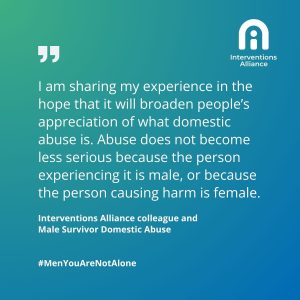
I am sharing my experience in the hopes that it will broaden people’s appreciation of what domestic abuse is. Abuse does not become less serious because the person experiencing it is male, or because the person causing harm is female.
- If you have been impacted by this story – help is available. For referrals to male domestic abuse refuge, please head to our contact page.
- You can also reach out to our partners ManKind for support.