


Beyond legislation: why preventing harm requires a collective approach to behaviour change
As new legislation brings greater accountability for harmful sexual content, an important question remains: how do we prevent harm before it occurs? Carl Hall, Director of Strategic Alliances at Interventions Alliance, draws on more than 15 years’ experience in probation and behaviour change to explore why legislation alone cannot address the attitudes and beliefs that underpin harmful behaviour – and why a collective approach is essential to creating lasting change.
Today (November 6), key provisions under the Crime and Policing Act 2026 come into force across England and Wales, creating new criminal offences relating to the possession and publication of certain pornographic material, including depictions of non-fatal strangulation, incestuous acts and adults pretending to be under 16.
These changes send an important message: the sexualisation of violence, coercion and children is not harmless entertainment. But while legislation can establish boundaries, create accountability and provide a framework for enforcement, it cannot, on its own, change the attitudes, beliefs and behaviours that underpin harm.
At Interventions Alliance, our work with people who have perpetrated domestic abuse, and vulnerable young people, reinforces a fundamental point: preventing harm requires more than responding to offending. It requires us to understand, challenge and change the attitudes and beliefs that can contribute to it.
What happens beyond the legislation? How do we challenge the normalisation of harmful sexual content, support people to recognise and question their own attitudes and intervene before distorted perceptions become harmful behaviours?
Challenging the influence of online content
Through our behaviour change interventions, including our Healthy Relationships and CURBB programmes for people who have perpetrated domestic abuse, we see how digital media can influence perceptions of relationships, power, control and consent.
Extreme pornographic themes have become increasingly accessible, while emerging technologies, including artificial intelligence, create new opportunities to produce highly personalised and potentially abusive sexual imagery. The ease with which someone’s likeness can be incorporated into violent or sexually explicit content raises further concerns about consent, exploitation and the normalisation of sexual violence.
Research by Sharman et al. (2024), exploring attitudes towards sexual strangulation among 4,702 Australians aged 18–35, illustrates just how embedded some harmful practices have become. More than half of those surveyed reported having experienced strangulation during sex, while 51% reported having strangled a partner.
Importantly, the research found that positive perceptions of sexual strangulation were associated with beliefs that it could be done safely and that it was an expected or socially normalised sexual behaviour. The findings also highlighted concerning assumptions about consent, with a significant proportion of participants believing that consent given on a previous occasion could be sufficient for future instances.
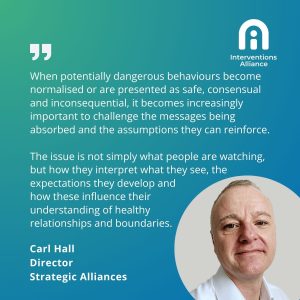
These findings raise important questions about the influence of pornography, media representations and wider social expectations in shaping people’s understanding of intimacy, risk and consent. When potentially dangerous behaviours become normalised or are presented as safe, consensual and inconsequential, it becomes increasingly important to challenge the messages being absorbed and the assumptions they can reinforce.
The issue is not simply what people are watching, but how they interpret what they see, the expectations they develop and how these influence their understanding of healthy relationships and boundaries.
Prevention must start earlier
Young people are particularly vulnerable to navigating an online environment where extreme sexual content can be readily accessible, often without the context or guidance needed to understand what they are seeing.
Without opportunities to question and critically engage with these representations, young people risk developing distorted understandings of intimacy, consent and boundaries before they enter adult relationships.
This is why prevention cannot sit with one service or sector alone. Education, health, social care, youth services and criminal justice all have a role to play in helping young people develop healthy relationship expectations, recognise harmful behaviours and understand the difference between what they see online and what respectful relationships look like in practice.
We also need to make positive representations of relationships more visible. Healthy relationship models, respectful communication and clear messages about consent need to be part of the environments in which young people learn and develop. Positive voices and influencers, such as Andrew ‘Bernie’ Bernard, can help bring these conversations into schools and other spaces where young people engage.
Turning legislation into meaningful change
No single organisation or sector can prevent this harm alone. Our experience of working across criminal justice, public health, local authorities and policing shows the importance of bringing different expertise together.
Violence against women and girls is not simply a criminal justice issue. It is a wider societal challenge that requires a coordinated response connecting enforcement with education, prevention, early intervention and opportunities for behaviour change.
For those working in frontline and helping services, the legislative changes should prompt some important questions:
- Are our teams equipped to respond to honest disclosures about exposure to harmful sexual content and attitudes towards violence?
- Can we have open, informed and non-stigmatising conversations with adults and young people about digital content, consent and harmful behaviours before they escalate?
- Are we creating opportunities in schools and community settings to challenge distorted perceptions and promote healthy relationships?
- Are our services working together to identify risks, share knowledge and provide opportunities for early intervention and behaviour change?
If the answer to these questions is no, we need to consider what more we can do.
As these new provisions come into force, law enforcement will have an important role in responding to offending and holding people accountable. But meaningful community safety also depends on what happens before, alongside and beyond that enforcement.
Legislation can set the boundary. Our collective responsibility is to help people understand why that boundary matters, challenge the attitudes that lead to harm and create the conditions in which behaviour can change.
For those of us working in criminal justice, public health, education, social care and community services, this is an opportunity to look beyond the boundaries of our own organisations and consider what we can achieve together.
Individually, we each have a role to play. Together, we have a much greater opportunity to create lasting change.