


Creativity, curiosity and change: What being a BCP really involves
Behaviour Change Practitioners do more than deliver intervention materials. They build relationships, ask questions, adapt their approach and help people explore what needs to change. Melissa Calvo shares what makes the role challenging, collaborative and rewarding.
Melissa knew she was passionate about forensic psychology and rehabilitation. After completing her studies, she worked as an Interventions Facilitator for the Probation Service, delivering domestic abuse and thinking skills interventions.
She already had an academic interest in the relationship between domestic abuse and stalking behaviours, so when the opportunity arose to deliver the Controlling and Obsessive Behaviour Intervention (COBI) with Interventions Alliance, she was excited to join the team.
Her experience has reinforced just how individual the process of behaviour change can be – and why the work calls for curiosity, creativity and a willingness to keep learning.
Why isn’t change straightforward?
There is no single reason why someone might struggle to change their behaviour.
Melissa explains that some people may hold deeply rooted beliefs about relationships, including how a relationship should look or how it should end. Others may have developed coping mechanisms in response to difficult experiences. Additional challenges, such as mental health difficulties or substance misuse, can also affect the process.
Changing behaviour can mean questioning beliefs that have been held for years or learning to respond differently when emotions are intense. Even when someone wants things to be different, trying a new approach can feel uncomfortable.
For Melissa, motivation involves being open-minded enough to recognise that an existing way of doing things isn’t working and being willing to practise alternatives.
It also means accepting that change may not feel easy. The process can involve uncertainty, reflection and confronting difficult questions – all of which make the support and structure of an intervention important.
Building trust while having difficult conversations
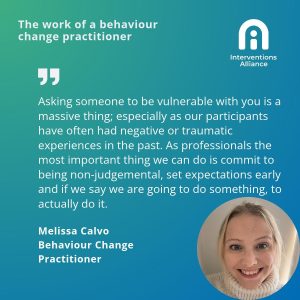
Behaviour change work often asks people to talk about experiences and behaviour they may find difficult to explore. Melissa recognises that asking someone to be vulnerable is a significant thing, particularly when they have had negative or traumatic experiences in the past.
She believes practitioners need to approach this work without judgement, establish clear expectations and follow through on what they say they will do.
Consistency matters. So does the therapeutic relationship between a practitioner and participant.
A strong working relationship can help people feel able to engage with an intervention, but it doesn’t mean avoiding difficult conversations. Practitioners need to maintain clear boundaries, support accountability and help participants examine the impact of their behaviour.
Effective interventions also need to be responsive to individual needs. Clear objectives and appropriate skills development matter, but so does the way the work is delivered and the rapport built along the way.
Creativity is part of the job
One thing Melissa thinks people might be surprised by is how much creativity can go into behaviour change work.
Practitioners work with people who have different starting points, experiences and needs. They therefore need to think carefully about how to engage participants, make intervention materials relevant and support people to apply what they learn.
The work is also collaborative. Practitioners work with colleagues and partner agencies, sharing information and professional judgements where appropriate to support effective interventions and manage risk.
For Melissa, the profession is also innovative because Interventions Alliance continues to develop its programmes and materials and rewarding because practitioners help people navigate difficult experiences while keeping safety in focus.
What does meaningful change look like?
Meaningful change is not the same for everyone.
For one person, it might be a significant shift in behaviour, such as complying with a legal order. For another, it might be being willing to speak with a professional for the first time.
What matters is recognising a meaningful shift from where the person started and understanding how that progress contributes to safer choices and reduced harm.
Melissa also highlights the importance of professional curiosity. Sometimes, asking an additional question or exploring something that doesn’t initially seem significant can lead to a better understanding of a person’s circumstances.
“There are no silly questions!” she says, emphasising that curiosity is key to being a BCP.
This doesn’t mean making assumptions or relying on instinct alone. It means remaining thoughtful, asking relevant questions and being prepared to explore what might otherwise be overlooked.
A role that keeps you learning
Melissa’s experience illustrates that behaviour change work brings together psychological knowledge, relationship-building, professional judgement and a willingness to adapt.
It is not always straightforward. Every person is different, and progress can take time. But that variety is also part of what makes the work rewarding.
As Melissa puts it, “Every day is different.”
For people who are interested in human behaviour and want to use their skills in practical work that aims to reduce harm, being a Behaviour Change Practitioner can offer a purposeful and continually developing career.
Could behaviour change be your next career?
You don’t necessarily need to follow the same route as Melissa to become a BCP. Experience in psychology, probation, social care, mental health, education and other people-focused settings may offer useful foundations.
What matters is a willingness to learn, an interest in understanding behaviour, the ability to build professional relationships and a commitment to supporting change while keeping people safe.
Interested in a career as a Behaviour Change Practitioner? Take a look at our latest vacancies and learn more about the role, the skills involved and opportunities to join our team.